Views: 0 Author: Site Editor Publish Time: 2026-10-13 Origin: Site
In industrial material handling, specifying the wrong lifting equipment introduces severe operational bottlenecks, accelerates equipment wear, and elevates workplace safety risks. Facility engineers and procurement teams must choose between a chain hoist and a cable (wire rope) hoist, a decision complicated by overlapping load capacities but vastly different mechanical footprints, duty cycles, and maintenance requirements. Selecting the incorrect system leads to premature component failure and unacceptable facility downtime. You need equipment that matches your specific production environment, whether that involves precise assembly tasks or heavy-duty continuous lifting. This guide provides an evidence-based breakdown of the mechanical differences, performance limitations, and maintenance realities for both hoist types to support a technically sound procurement decision. We will examine the engineering principles behind each design, helping you align your facility's operational demands with the correct lifting technology.
Capacity and Application: A chain hoist is typically optimal for loads under 10 tons and applications requiring true vertical lift in compact spaces, whereas cable hoists are engineered for heavy-duty lifting (up to 100+ tons) and high-speed operations.
Mechanical Footprint: Cable hoists require a grooved drum, resulting in a larger physical footprint and potential lateral hook drift, while chain hoists utilize a compact sprocket system that maintains a consistent center of gravity.
Maintenance Realities: A chain hoist generally offers lower upfront costs and simpler maintenance routines; wire rope hoists require rigorous inspection for fraying, crushing, or core failure.
Duty Cycle Alignment: Selecting the correct hoist requires matching the equipment to specific ASME/CMAA duty cycle classifications to prevent premature motor or brake failure.
Table of Contents
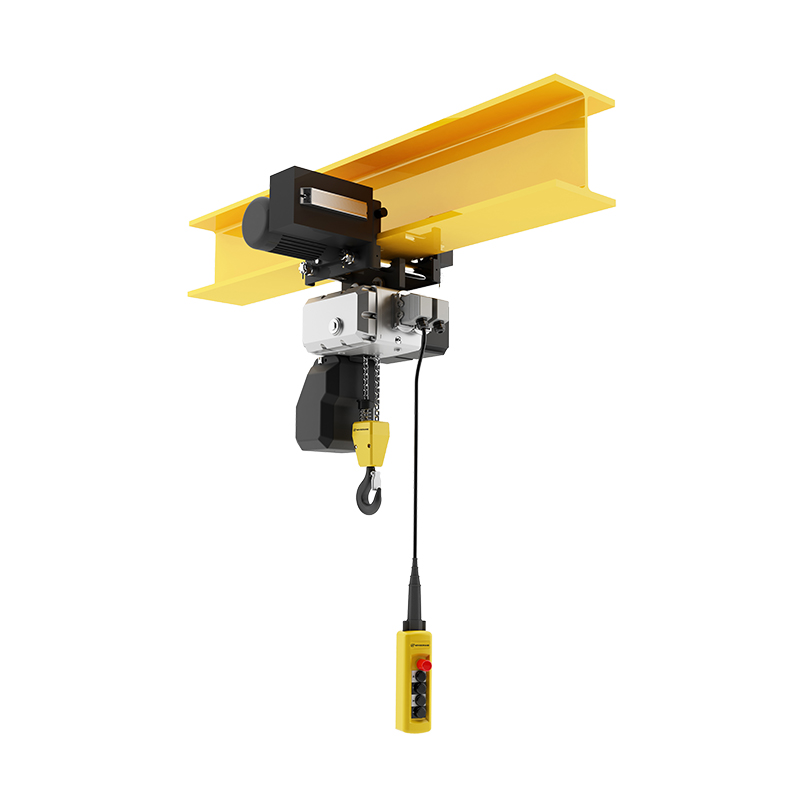
The fundamental operating principle relies on a hardened steel link chain pulled over a motorized or manual pocketed sprocket, known as a load sheave. The pockets in the sheave are machined to match the exact pitch and diameter of the chain links. As the motor turns the sheave, the links engage with the pockets, lifting or lowering the load block. You can integrate a chain hoist into various overhead crane systems to achieve reliable vertical lifting. The chain links must seat perfectly into the sprocket pockets. If they do not align, the mechanism jams. This requires tight manufacturing tolerances and consistent chain lubrication.
A primary design advantage is its highly centralized mechanical footprint. The slack chain falls directly into a chain container or hangs vertically below the hoist body. This configuration ensures the equipment maintains a compact profile. It does not require a wide horizontal space to store the lifting medium. This makes it exceptionally useful in cramped manufacturing cells, narrow maintenance bays, or above crowded assembly lines where overhead space is restricted.
This design inherently provides true vertical lift. Because the chain feeds over a single stationary axis, the load does not shift laterally during the lifting process. The hook travels straight up and straight down. Applications like machining center loading or custom fabrication require this exact vertical alignment to prevent damaging expensive components. When operators lower an engine block into a chassis, they cannot accommodate horizontal drift. The sprocket design eliminates this variable entirely.
Wire rope hoists use a motor-driven drum to wind steel wire rope and lift heavy loads. Their design supports high lifting capacities and long lifting heights but generally requires more installation space than chain hoists. Double-reeving configurations can minimize lateral hook movement, improving lifting stability and positioning accuracy.
Chain hoists are available in manual, electric, and pneumatic configurations, offering flexibility for different working environments. Their compact structure makes smaller models suitable for portable and temporary lifting applications. Wire rope hoists are typically electrically powered and installed on fixed overhead cranes or motorized trolleys for industrial operations.
Chain hoists are commonly used for light to medium lifting loads, typically from 0.125 to 10 tons, although higher-capacity models are available. Wire rope hoists are often preferred for heavy-duty applications involving loads of 10 tons or more. Actual capacity depends on equipment design and manufacturer specifications.
Chain hoists are suitable for standard lifting heights and moderate operating speeds, while wire rope hoists generally offer advantages for long lifting distances and high-speed operations. Their drum-based design accommodates longer lifting ropes, making them suitable for large industrial facilities and high-throughput applications.
Hoist duty cycle determines the equipment's suitability for repeated or continuous lifting. Chain hoists are commonly used for light to medium-duty applications, while heavy-duty wire rope hoists are often designed for demanding production environments. Selection should consider load frequency, operating hours, motor starts, and applicable duty classifications.
Variable Frequency Drives (VFDs) provide smooth acceleration, deceleration, and precise positioning for both chain and wire rope hoists. Chain hoists can offer minimal lateral hook movement, while double-reeved wire rope hoists help maintain stable vertical lifting. Both technologies can support accurate load placement in industrial assembly and manufacturing.
Feature | Chain Hoist | Cable Hoist |
|---|---|---|
Optimal Load Range | 1/8 Ton to 10 Tons | 10 Tons to 100+ Tons |
Lift Height | Limited (Typically under 50 ft) | Extensive (Can exceed 100 ft) |
Lifting Speed | Moderate | High |
Lateral Hook Drift | None (True Vertical Lift) | Present (Unless double-reeved) |
Physical Footprint | Compact | Large and Wide |
Headroom and installation space are important factors when selecting chain or wire rope hoists. Chain hoists often provide compact designs and can be combined with low-headroom trolleys to maximize lifting height. Proper selection should consider ceiling clearance, beam dimensions, trolley configuration, and required lifting height.
Industrial operating conditions affect hoist durability and maintenance requirements. Chain hoists may offer advantages in dusty or corrosive environments when equipped with suitable materials and lubrication. Wire rope hoists require proper rope protection and maintenance. Hazardous locations may require specially certified pneumatic or explosion-protected lifting equipment.
Noise levels vary depending on hoist design, speed, and operating conditions. Chain hoists may produce noticeable noise from chain and sprocket engagement, while wire rope hoists often provide smoother and quieter operation. Equipment selection should consider workplace noise requirements, operator comfort, and lifting frequency.
Regular inspection and lubrication help maintain safe hoist operation. Chain hoists require checks for link wear, elongation, twisting, and proper lubrication. Wire rope hoists require inspections for broken wires, kinks, corrosion, and diameter reduction. Maintenance should follow manufacturer recommendations and applicable safety standards.
Component replacement requirements differ between hoist types. Chain replacement typically involves installing and correctly routing a new load chain, while wire rope replacement requires careful drum winding, anchoring, and reeving. Qualified technicians should perform replacement procedures to ensure proper operation and minimize downtime.
Chain hoists may experience chain twisting, excessive elongation, or load sheave damage. Wire rope hoists can suffer from broken strands, improper spooling, or rope crushing. Regular inspections, correct load alignment, and avoiding shock loading help prevent equipment damage and lifting accidents.
OSHA regulations and applicable ASME B30 standards provide safety guidance for hoist operation, inspection, and maintenance. ASME B30.16 covers overhead underhung and stationary hoists, while ASME B30.2 applies to certain overhead and gantry cranes. Facilities should establish appropriate inspection schedules, maintain records where required, and remove defective equipment from service.
Audit your facility's specific load requirements by calculating the maximum weight of the heaviest component you intend to lift.
Measure the available headroom from the bottom of the support structure to the required highest hook position.
Determine your CMAA duty cycle class by calculating the average number of lifts per hour and the average load weight.
Establish a daily and monthly inspection protocol based on ASME B30 standards before operating the new equipment.
Consult with a structural engineer or certified crane builder to verify that your existing runway beams can support the dynamic loads of the selected equipment.
A: It is generally not recommended for continuous Severe Duty (Class E or F) applications. The compact motor housing limits heat dissipation. Continuous operation near maximum capacity causes the motor to overheat. For continuous heavy-duty production, a wire rope unit with superior cooling capabilities is required.
A: True vertical lift means the hook travels straight up and down without any lateral horizontal movement. It matters because it allows for precise load positioning. This prevents damage to sensitive components during assembly and ensures the load does not swing dangerously when lifted from the floor.
A: Lifespan depends entirely on the operating environment and maintenance. A load chain generally lasts longer in abrasive or dusty environments because it does not require sticky lubrication. Wire rope degrades quickly if dust mixes with its grease, but it lasts for years in clean, well-maintained environments.
A: Upgrading is possible but requires a structural engineering review. Cable units are significantly heavier and have different dimensional footprints. You must verify that your existing bridge beam, end trucks, and runway structure can safely support the increased dead weight and dynamic loading.
A: Chain-driven units are generally better for cleanrooms and food-grade facilities. They can be equipped with food-grade lubricants or run dry. They can also be manufactured from stainless steel. Wire rope requires heavy lubrication that can drip and contaminate the clean environment beneath the crane.
A: Yes. In explosion-proof environments, pneumatic units are required. They use compressed air instead of electricity, eliminating the risk of electrical sparks. They are also fitted with spark-resistant components, such as bronze hooks and stainless steel load chains, to prevent mechanical sparking.